March 12, 2009

RWR 2

Random Writer's Resource 2

CS Weekly

Published by Creative Screenwriting magazine, this e-mail newsletter contains more than enough distractions for the truly procrastinating writer. The news, interviews, and reviews are all useful for screenwriters at any level. For free, you can’t go wrong.

March 10, 2009

Hyphenate

“Hide not your talents, they for use were made.  What’s a sun-dial in the shade?” – Benjamin Franklin

The Hollywood buzzword for industry folks who are more than just actors or directors or writers is hyphenate.  I’m seeing in more and more books and articles the recommendation from Hollywood insiders is to establish yourself as a hyphenate before expecting to garner much attention from Tinsel Town.  Good or bad, the ability to make yourself a hyphenate is getting easier and easier.

Many claim to be several, if not all, of the following: writer, director, producer, editor, puppeteer, dentist, lawyer, Olympian.  With digital-video-making being as cheap as it is and YouTube being as accessible as it is, anybody anywhere can write, direct, produce and distribute as much crap as they want.

So is it a good idea?  I’m not of authority to say.  I do think it’s best to avoid as much as possible dropping turds all over the Internet.  (Ah, poetic euphemisms…)  Make good stuff.  Put it out there.  See what happens.  Then when you sell that screenplay of yours that you, and only you, can direct, Hollywood may actually trust you to do so.

March 6, 2009

Produce

“When one door closes, another door opens.  But we often look so long and so regretfully upon the closed door, that we do not see the ones which opened for us.” – Alexander Graham Bell

It’s hard to beat fresh raspberries picked right off the bush or broccoli just snapped off the stalk.  I was spoiled as a kid with succulent, fresh produce all summer long.  Of course, this entry’s title is more relevant with a second syllable emphasis.

Frustrated by the seemingly impenetrable shell that protects Hollywood from newbie screenwriters, I figured I may as well produce a movie myself.  That way, I could list ‘produced screenwriter’ on my resume.  The motivation, of course, went well beyond resume boosting.  Truth is, I just want to make movies, and if Hollywood isn’t interested in seeing what I have to offer on the page, maybe I can get them to notice something on the screen.

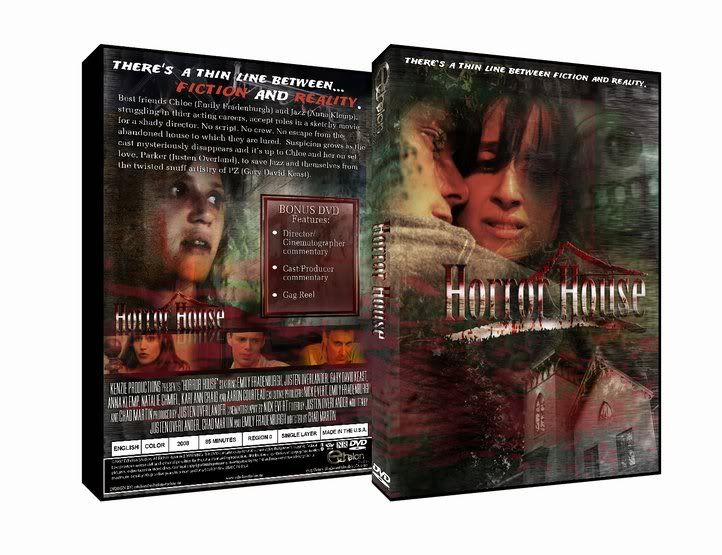
My research in independent filmmaking made it clear the easiest sell for a neophyte producer is horror.  The foreign markets eat up American scare fare.  Had I avoided a few key mistakes, I think Horror House could have made a bigger dent in the domestic and foreign markets.  I’ll explore those mistakes in upcoming entries.

As it is, I’m proud of my first self-produced feature.  Creating a movie and seeing it through to its completion is an accomplishment of which few can boast.  And I think it was a necessary experience in my growth as a Hollywood contender.

Reflections on the entire production process can be found in my Horror House movie blog.  Shooting the movie was an incredible experience with an incredible cast and crew, and I hope to emulate that adventure again and again.

You can buy Horror House here, or via a forthcoming link in one of the sidebars of this site.

March 2, 2009

It

“When people talk, listen completely.  Most people never listen.” – Ernest Hemingway

When Rima Greer talks, I listen.  She’s been agenting longer than I’ve been driving.  In 25 years she has yet to sign a screenwriter who wasn’t referred to her by an industry professional.  Gulp.

Without an insider’s track, it is essential to be extra cognizant of the traits for which literary agents are looking.  As mentioned last entry, being good is first and foremost, but it’s not enough.

According to Ms. Greer, 99.9% of the time, a writer is hired because he or she is good in a room, not necessarily because he or she is compellingly better than the other writers up for the job.  You have to be good, of course, but if you reach the stage of potential employment as a scriptwriter, it’s already understood you’re good.  So you’d better be charming.  You better listen well.  You’d better have charisma (a word that will come up in future entries).

You also need to understand people and situations.  As The Gambler himself stated, “You gotta know when to hold ‘em; know when to fold ‘em; know when to walk away; and know when to run.”  Put another way, you need to know when to talk and when to shut up.  I know, I know – I’m working on that one.  I’m working on all the intangibles.

Truth is, I think I meet the requirements outlined by Ms. Greer.  If I didn’t think this way, I’d be wasting a lot time, effort, and money, not to mention jeopardizing my future and my family’s financial security.  Like so many others, I’m just waiting for that one phone call, that one connection, that one moment when the stars align and the carrot is finally mine.  Waiting?  No, pursuing.

In my three or so years of off-and-on querying, only three times has a full screenplay of mine been requested, leaving my batting average right around .023.  One request led to an option and another led to a dialog back and forth with a couple rewrites in between before both sides mutually agreed our directions for the project were out of sync.  By those statistics, I’m actually batting quite well.

But I’ve sent out over a hundred letters, made close to as many phone calls, and sent seven singing telegrams.  Okay, no telegrams.  Good thing, too, because Ms. Greer makes it clear that nobody in Hollywood appreciates gimmicks or brownnosing.  Ass-kissing?  Totally different story.

And I’ll keep sending queries, keep making phone calls, maybe make a trip or two to LA in the coming months.  All for a chance to prove to somebody that I have it.

But who am I to think I’ve got it?  I don’t know.  But if I harbor any doubt, then I don’t have what it takes to survive in Hollywood.  Bring on the sharks!

22

“Looking for [new] clients is the last thing [literary] agents do… So, how the hell do you get an agent if none of us are remotely interested in taking the time to find you in the first place?  I don’t know.  Really, I don’t.” – Literary Agent, Rima Greer, from her book, The Real, Low Down, Dirty Truth About Hollywood Agenting

Ms. Greer goes on to say she’s never signed a client from a query letter.  Great news for someone trying to break in as a screenwriter, huh?  Luckily, Ms. Greer does know a few agents who have signed querying writers.  In the words of the immortal Lloyd Christmas, “So you’re saying there’s a chance…”

In an industry built on Catch-22s, this one frustrates me as much as any: You can’t sell a screenplay without an agent, and you can’t get an agent until you sell a screenplay.  Of course, the ‘can’ts’ are used for effect and are too absolute for unreserved validity.  But I would guess this Catch-22 is at least 99% true.

I’ve read from more than one source, “if it was an easy business, everyone would be doing it.”  There’s a good reason Hollywood doesn’t invite every Dom, Rick, and Larry to write her movies – most people aren’t any good at it.  I’ve read a lot of bad scripts.  A lot.  (Quick note… yes, ‘a lot’ is a phrase, not a word.  There is no ‘alot’ in the dictionary.  Before writing a screenplay, please study the English language.  Just a little.  But I digress.)

My first drafts are bad.  My second drafts are bad.  Finally, by the third, fourth, and fifth drafts, my screenplays are starting to take shape.  It’s a long, tedious process to give birth to a quality screenplay.  I’m still tweaking stories I started five or more years ago.  Why so many wannabe screenwriters are delusional enough to think they are above the laws of writing is a perplexity I’ll never solve.

Of course, a bad story is a bad story no matter how many times you rewrite it.  Appropriately, Rima Greer’s first suggestion to aspiring screenwriters is to be good.  She doesn’t say as much, but I would aver that goodness starts at conception (on so many levels, right?).  The development of the idea, the molding of the characters, the execution of functional, succinct dialogue – all facets must come together to form a recognizable pattern while being completely original.  Huh?  Yeah, that’s another Catch-22: Hollywood is looking for proven entities that are completely original.  And I’m looking for lettuce that tastes like ice cream.

More soon from Ms. Greer’s wonderful book.