Showing posts with label book review. Show all posts

March 2, 2017

So you're telling me there's a chance...

"Nothing gives me greater satisfaction than helping nurture talent to do the best they can in the audition process." - Casting Director, Lisa London, from her book, From Start to Stardom


Last week I auditioned for a television show and the casting director took a phone call in the middle of my audition. Seriously.

Needless to say, I figured my chances of booking the role were pretty slim. And yet... like Lloyd Christmas (Jim Carrey), I always hold out optimism no matter how stacked the odds seem against me.

That's the attitude anybody going into this crazy business has to have. I've written about odds and statistics many times. The older I get, the more stacked against me the odds become.

But I know there's still a chance. And that's what keeps me going. Whether it's one in a hundred, one in a million, or, to borrow my 4-year-old's expression, one in infinity and beyond, I know there's still a chance.

Casting Directors like Lisa London also keep me going. In a town where obstacles can appear insurmountable, Lisa reminds me that many are fighting to help us achieve our dreams.
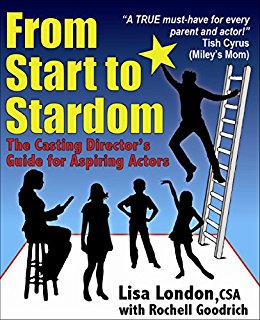
Visit fromstarttostardom.com to order the book
and find even more great acting resources!
With a long list of casting credits that includes Roseanne, Hannah Montana, Adam Sandler's Sandy Wexler, and a handful of projects currently in pre-production, Ms. London certainly has the experience to validate the advice she gives in her amazing book, From Start to Stardom: The Casting Director's Guide for Aspiring Actors.

At my advanced age - and with nearly 20 years of professional acting experience - I shouldn't still be labelled aspiring, but until I'm fully supporting my family on paychecks from acting jobs, that's exactly what I am. And, really, no matter what stage one is at in a career, one should always aspire to learn and become better equipped for further success.

For those just getting started as actors, I can't recommend From Start to Stardom enough. This is, honestly, the best beginner's guide to the acting business I've ever read... and I've read a ton of books on the subject. This is a must-read for aspiring actors of any age and parents of aspiring actors.

Lisa's approach is so uplifting and positive that it's easy to get lost in the glamour of becoming a star in Hollywood. When she writes about casting Miley Cyrus as Hannah Montana, Miley's first professional acting gig, it's easy to get lost in the dream and put oneself in the shoes of Billy Ray's daughter. But Lisa also reminds us just how miraculous it is to be "the one" for any role in any project.

Lisa London, CSA
What Lisa does so well in From Start to Stardom is break down the steps necessary for finding success. She provides sample resumes, offers headshot advice, explains how to get discovered, and uncovers the best ways to land an agent and/or manager. Then she tackles the next stages of a career by offering audition tips and explaining what goes on behind the casting director's door. The book even includes legal information for minors working in show business as well as a ton of resources for everything from the Screen Actors Guild to websites that list auditions to Los Angeles studio locations. The teacher in me is giddy with the comprehensiveness of Lisa London's book!

Again, this is a must-own book for beginning actors, but any actor, regardless of their career level, will benefit from these 166 pages. One paragraph in particular was just what I needed to read, and it came at it exactly the right time. With permission, I've included the paragraph here:

"Another killer of opportunities and creator of bad attitudes is self-invalidation. What is self-invalidation? It is making less of yourself, putting yourself down, focusing on your faults, thinking you are no good and that you will never meet your goals. This is something that will kill you as an actor or an artist. Sometimes, these ideas that you are no good, these negative thoughts, are things that you have heard from others. For example, you have a relative or friend who thinks you will never make it as an actor. You can't let your family's difficulties or lack of success become your problem. You must keep your dreams separate and not give up based on someone else's failures." (p. 107)

Man. I love these words. I need these words. Can you feel me? Leave a comment and let me know how these words make you feel.

Now, the flip-side to all of this is the harsh reality that more actors fail in this business than succeed. Look at me. While many would love to be in dozens of commercials, star in a bunch of independent features, have leading roles on cable shows, or an appearance on the number one television drama in the world, my bar is set at a level that I haven't even come close to reaching. At what point does common sense walk in and slap me across the face and convince me the bar is unattainable?

With apologies to some, the answer is, never.

This is my gift. I didn't ask for it, but here it is. I'm constantly asking God to be specific in how He wants me to use this gift. So far, I have to assume I've been on the right track. Only time will tell if my expectations align with His, but the path, I feel, has been the correct one for me; for my immediate family; for those with whom God wants me to interact.

Like most actors, I'm currently somewhere between start and stardom, and while I don't know if I'll ever reach the stardom end, I know if I'm persistent, I will be successful. That's what this business comes down to -- persistence. Dreams need not expire.

For those who desire a career in the movie business, specifically as an actor, get Lisa London's From Start to Stardom. Focus more on the start than the stardom and see what happens. As Eleanor Roosevelt said, "The future belongs to those who believe in the beauty of their dreams."

I'm telling you there's a chance.

Visit http://fromstarttostardom.com to buy the book and learn more about the acting business!

June 9, 2014

I'm crying because I didn't think of this

There are things I wish I would have created. Like the iPhone and Disney World.

Then there are things I'm happy I didn't create. Like sauerkraut and The Real Housewives of Wherever.

This brilliantly funny book falls into the former category:


I mean, come on. It's cute, funny, and so ridiculously simple. Like me. Except for the cute and funny part.

Can you guess from the title what it's about?

No. It's not about baby goats. Or Storck Chocolates.

It's a bunch of pictures of kids crying with captions explaining the reasons they are crying.

So simple. So brilliant. Like me. Except for the brilliant part.

It all started with the blog of a father raising his kids during the day while moonlighting in a creative field. Sounds a little familiar.

I'm inspired now to change the content of my blog. From now on, I'm going to go around to parks, beaches, schools, and church nurseries to make kids cry so I can take their picture and make up funny captions.

Wait a sec. Kids cry enough on their own. For reasons more ridiculous than I could ever invent. And that's what makes Greg Pembroke's book and blog so brilliantly simple and charming. Like me. Except for the brilliantly charming part.

As a parent of three creatures that can go from sobs to laughter and back again in less time than it takes me to forget what I'm looking for in the fridge, Reasons My Kid is Crying struck a chord with me and is sure to do the same for other child overlords.

That's what creators need to do. Create things that resonate with an audience. It doesn't have to strike a chord with every audience, but it needs to connect to some audience. And it's not always about the size of the audience but the loyalty of the audience.

I know there's an audience out there for my Naked Gun soap opera. A big, loyal audience, aged 18-49, that spends a lot of money on products they see in commercials.

But I digress.

Hey, how about my own contribution to Reasons My Kid is Crying?:


July 12, 2013

"Plastic Donuts" by Jeff Anderson is a great introduction to spiritual giving

As a member of Waterbrook Multnomah Publishing Group's Blogging for Books program, I get free copies of Christian books in exchange for posting reviews.  With MN 2 Hollywood focused on the film and television industry, the books are often not particularly in line with my purposes for maintaining this blog.

But my faith is important to me.  Not because I want to shove it down other folks' throats, but because the core teachings of Jesus Christ center on loving God and each other.  Christianity aside, nobody can convince me that love is not the exact thing this world needs.

The most recent book I read through this program is "Plastic Donuts" by Jeff Anderson.  It's about tithing, giving to God a portion of what He first gave us.  My view of tithing is likely inconsistent with the view of most Christian leaders in this country.  I don't believe we are called to give specifically to a church, but to give to outlets to which God leads us to give.  This very well may be a church (or churches), but it could also be a charity dedicated to helping others.  I believe we are called to spread the gospel of love that Jesus preached while He was living among us.  I don't believe we are required to fund fancy sanctuaries, extravagant light and sound systems, and inflated pastoral salaries.

But that's another topic for another time.

Here's the review I posted at Amazon for "Plastic Donuts."  I truly do think it's worth a read, especially if you've been hesitant in the past about tithing.

This is a short, easy read. Light on theological jargon, heavy on practical insight, Plastic Donuts is a great introduction to the idea of spiritual giving.

Rather than pound out black and white laws about giving, author Jeff Anderson approaches the subject in a loose manner. He doesn't answer longstanding questions about whether a 10% tithe is intended to come from one's net earnings or gross earnings or whether or not 10% is the benchmark for being right with God. It's a matter of giving what one's heart feels compelled to give, whether it be more or less than 10% and whether that 10% is calculated to the penny off gross or net income.

Nor does he demand a person's tithe go entirely to one's church. Spiritual philanthropy is a far too often overlooked calling for God's people, and Mr. Anderson's words inspire readers to cheerfully give back to God a portion of what He first gave us, whether that be directly to church or to help our brother man.

The parallel between a child offering her father plastic food and God's children offering a portion of their finances to Kingdom work is a little thin, but the message within these concise pages is desperately needed, especially in today's first-world consumerism.

April 20, 2012

The Richest Man Who Ever Lived, by Steven K. Scott

"Generosity starts in the heart. It always takes action, and it is never passive." - Steven K. Scott, from The Richest Man Who Ever Lived


I'm always looking for financial advice.  As someone who has never, ever been a member of the affluent or  semi-affluent or even quasi-affluent, I've always had to be careful about handling money.  I'd like to experience a life in which every significant purchase isn't crippling.


So when I got a free copy of The Richest Man Who Ever Lived, I was anxious to learn the secrets to creating a more comfortable lifestyle.  Unfortunately for me, I'm already applying (or at least trying to apply) every suggestion from said book.  I'm sure not rich from a financial stance, but I'm wealthy in more important ways.


Still... I look forward to being both!


For anyone interested, here's a review of the book:


The Richest Man Who Ever Lived is essentially a commentary on the Old Testament Book of Proverbs. That can’t be a bad thing. After all, Proverbs contains moral truths universally applicable regardless of one’s faith or lack thereof.


Despite its title, the book is not a guide for getting rich - at least not financially. While applying author Steven K. Scott’s suggestions can certainly contribute to financial gain, the core objective of the book is to provide a framework for achieving wealth in non-monetary forms.


Some readers may be disappointed that a book about the richest man who ever lived (the Old Testament’s Solomon) is not a get-rich financially guide, but rather a get-rich personally guide. True wealth comes not from the digits in a savings account, but from the peace within one’s heart and mind.


But who wouldn’t want a little more money? The Richest Man Who Ever Lived includes the author’s personal experiences of financial gain and loss, the latter of which was always the result of ignoring Solomon’s advice from the Book of Proverbs. When the author heeded Solomon’s advice, his financial success is, at least as much as the author admits, flawless.


The Richest Man Who Ever Lived is not a get-rich guide, but it will help readers manage their finances and personal and interpersonal habits more effectively.


Read Chapter 1 of The Richest Man Who Ever Lived.


I received this book for free from WaterBrook Multnomah Publishing Group for this review.